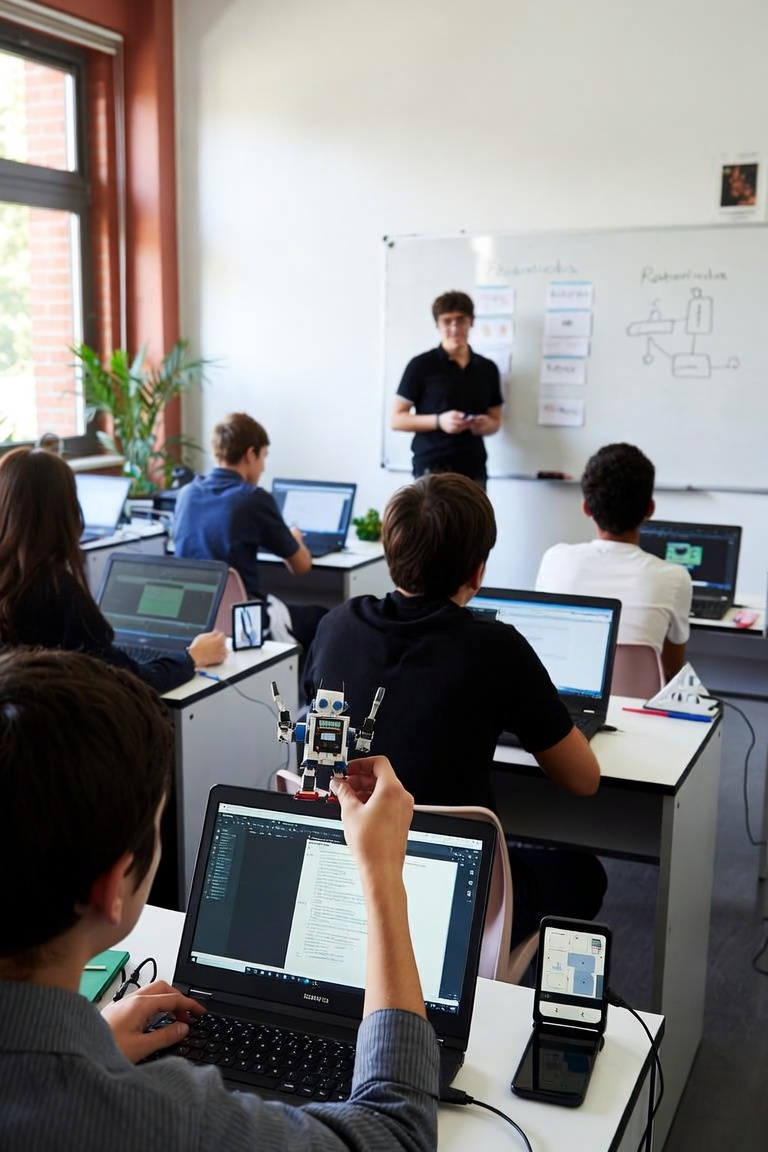
The gap between what colleges teach and what employers actually need has never been more visible. Across manufacturing, automation, and engineering, companies are hiring — yet qualified candidates are harder to find than ever. The issue isn’t a shortage of graduates. It’s a shortage of graduates who can walk onto a shop floor or into an automation facility and contribute from day one.
Employers aren’t just looking for theoretical knowledge. They want people who’ve worked with real systems, debugged real problems, and built real things before graduation. Robotics education is emerging as one of the most effective ways colleges are responding to that demand. By building programs that put students in direct contact with the technology shaping modern industry, institutions are creating graduates who are genuinely ready for work.
1. Bringing Industry Equipment Into the Classroom
One of the most direct ways colleges are bridging the gap is by investing in robotics labs that replicate real workplace environments. Instead of learning from diagrams or outdated demonstrations, students work with industrial-grade systems — the kind they’ll encounter in actual jobs.
This shift matters because familiarity with specific equipment gives graduates a head start. A student who has programmed a robotic arm, calibrated a sensor array, or troubleshoot an actuator failure isn’t starting from zero when they enter the workforce. They arrive with operational confidence that purely classroom-based learning simply can’t produce.
Some programs have gone a step further by designing labs that mirror the layout and workflow of real manufacturing or engineering environments. That physical context — not just the equipment itself — trains students to think and respond the way working professionals do.
2. Combining Theory With Practical Application
There’s nothing wrong with engineering theory. Understanding the principles behind motion control, feedback loops, or mechanical design is genuinely important. The problem is when theory is the endpoint rather than the foundation.
Colleges that integrate robotics effectively use theory to frame hands-on projects, not replace them. Students apply what they’ve learned in lectures by building, testing, and refining actual systems. That process develops something textbooks can’t easily teach: the ability to diagnose a problem in a live system and work through it under pressure.
Problem-solving confidence is one of the qualities employers consistently say recent graduates lack. Robotics programs that pair theoretical instruction with real project work are directly addressing that gap in a way that’s hard to replicate any other way.
3. Teaching Automation and Industry 4.0 Skills
Modern manufacturing isn’t just about machines — it’s about interconnected, data-driven systems. Industry 4.0 has transformed the floor of a factory into a network of sensors, programmable controllers, and automated decision-making tools. Graduates entering this environment need to understand more than mechanics.
Robotics education at the college level increasingly incorporates:
• Programmable Logic Controllers (PLCs) and industrial automation software
• Sensor integration and data acquisition systems
• Human-machine interface (HMI) design and programming
• Basic data analysis and process monitoring
These aren’t niche specializations anymore — they’re baseline expectations in most advanced manufacturing and engineering roles. According to the World Economic Forum, automation and robotics are among the top drivers of workforce change globally, and demand for workers who understand these systems is accelerating. Colleges that build these skills into their programs are producing graduates employers actively compete to hire.
4. Creating Project-Based Learning Opportunities
Team-based engineering projects do something individual assignments can’t: they simulate the actual conditions of professional work. Students have to communicate across different areas of expertise, divide responsibilities, manage timelines, and integrate their individual work into a functioning whole.
When that project involves a real robotics challenge — building an autonomous system, programming a manufacturing process, or designing a robotic competition entry — the stakes feel real even if the context is academic. Students learn how to handle setbacks, negotiate design tradeoffs, and test iteratively rather than trying to build something perfect from the start.
These are exactly the soft and technical skills that hiring managers say they struggle to find in new graduates. Project-based robotics education develops both simultaneously, which is one of the reasons it has become a priority at institutions that take workforce readiness seriously.
5. Partnering With Industry to Align Curriculum
A robotics program designed in isolation from industry is always going to drift out of alignment with what employers actually need. The technology changes too fast, and the specific skills in demand shift with it. Colleges that understand this have started building formal and informal partnerships with companies to keep their curricula current.
These relationships take different forms. Some colleges establish advisory boards made up of industry professionals who review and contribute to program design. Others arrange internships, co-ops, or capstone projects in partnership with local manufacturers or technology firms. Some run equipment donation programs that give students access to current-generation tools.
The result is that graduates emerge having worked with the systems, terminology, and workflows that employers recognize — not a college’s interpretation of what industry looks like. That alignment reduces the onboarding burden for employers and gives graduates a meaningful advantage when competing for roles.
6. Building Scalable Learning Ecosystems, Not Just Labs
While having robotics equipment in a lab is important, it alone doesn’t guarantee strong learning outcomes. What separates effective robotics programs from average ones is the broader learning ecosystem built around that equipment.
Modern robotics education depends on structured training platforms, simulation tools, standardized learning modules, and curriculum resources that evolve alongside industry practices. These elements allow students to progress from basic concepts to complex system design in a structured way, rather than relying only on access to physical hardware.
In addition, well-developed instructional frameworks help instructors keep pace with rapidly changing technologies. Robotics is not a static field—new control systems, programming environments, automation standards and robotic parts emerge regularly. Renowned providers of robotic parts, like Studica, ensure to offer the latest robotic parts to enhance learning skills of the students. Programs that invest in updated teaching materials, modular course design, and instructor training are better positioned to keep students aligned with industry expectations.
Some institutions also integrate cloud-based robotics platforms and remote access systems, allowing students to work on projects outside the physical lab environment. In this sense, the real value is not just in the machines themselves, but in the infrastructure that supports consistent, scalable, and up-to-date robotics education.
7. Strengthening Access to Modern Robotics Components and Learning Tools
As industries continue to evolve, the emphasis is shifting from purely academic qualifications to demonstrated capability. Employers increasingly value graduates who can adapt quickly, work with modern automation tools, and contribute to problem-solving in real time.
This is why hands-on robotics training has become such a critical part of modern technical education—it builds not just knowledge, but job-ready competence that aligns directly with industry expectations.
The Conclusion
Robotics education isn’t a trend — it’s a structural response to a genuine workforce challenge. As automation continues to reshape manufacturing, logistics, healthcare, and dozens of other sectors, the demand for people who can work alongside and within automated systems will only grow.
Colleges that invest in practical, hands-on robotics programs — with the right equipment, strong industry partnerships, and project-based learning at the center — are doing something more than teaching technical skills. They’re producing graduates who are ready for the workforce as it actually exists, not as it existed a decade ago.
For students choosing where to study, and for employers thinking about where to recruit, that distinction is becoming one of the most important factors in the equation.lly was.
The companies that get the most value from an upgraded strategy are the ones that act before any of those events force the issue. If several of the situations above feel familiar, the conversation about what a better approach looks like is worth having now — while the window to be proactive is still open.