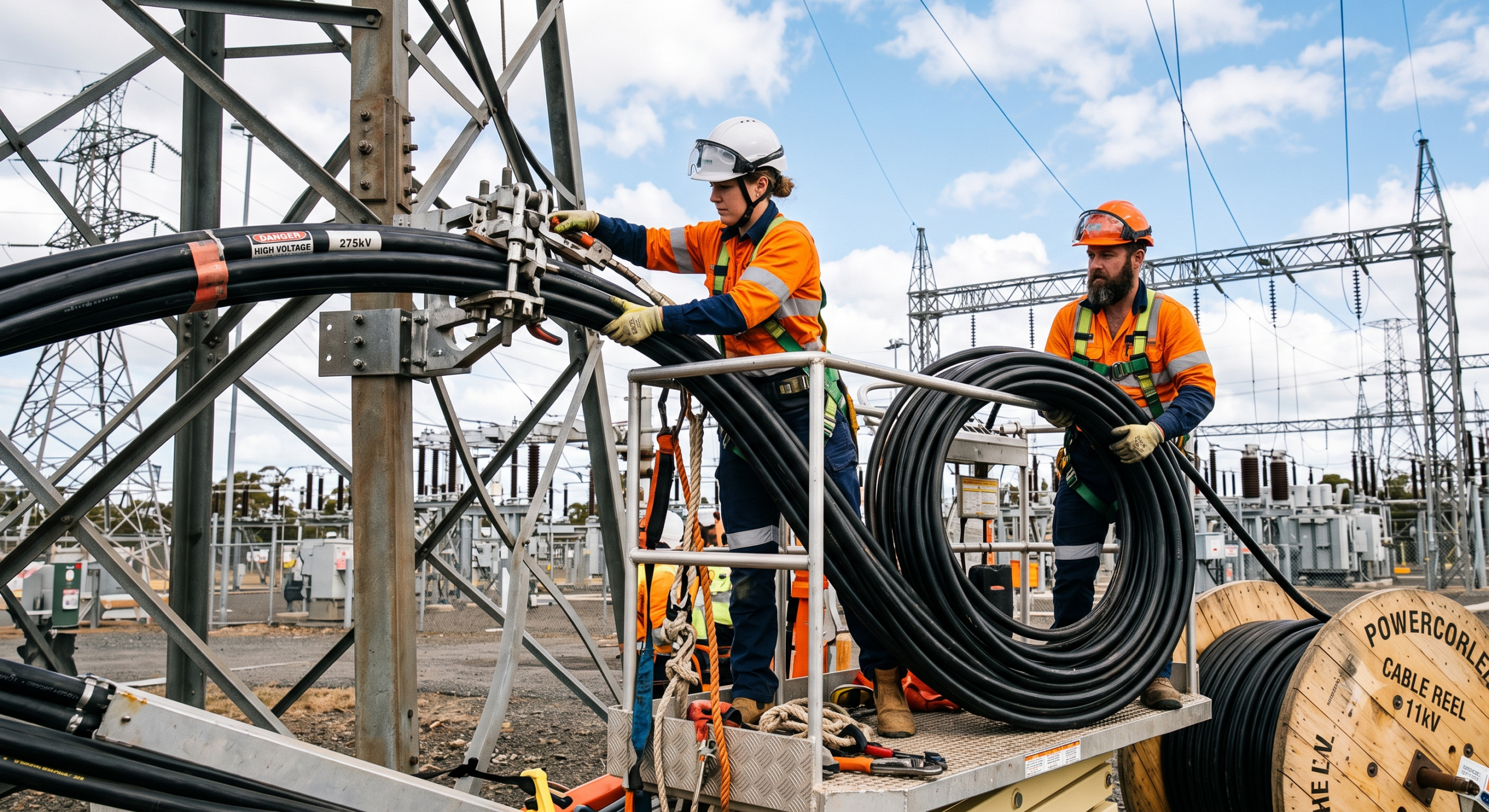
Frontline workers — the people on the floor of a warehouse, at a construction site, or in a manufacturing facility — don’t get the luxury of a quiet office to think through problems. They’re making decisions quickly, often in loud, physically demanding, and hazardous environments. Every unnecessary friction point in their day adds to mental fatigue.
That’s what cognitive load means in practice: the mental effort required to do a job. When equipment is awkward, unreliable, or poorly designed, workers spend mental bandwidth managing their tools rather than focusing on the task itself. Power cables are a surprisingly significant part of that equation.
Mentioned below are several ways how the right power cables can reduce cognitive load for frontline workers.
1. Understanding Cognitive Load in the Workplace
It’s easy to think of cognitive load as an abstract concept — something relevant to knowledge workers, not someone operating machinery. But research tells a different story. In physically demanding roles, cognitive fatigue increases error rates, slows response times, and raises the risk of accidents.
According to the Occupational Safety and Health Administration (OSHA), poorly designed workplaces — including equipment and tool layouts — directly contribute to musculoskeletal disorders and reduced situational awareness, both of which are closely linked to cognitive overload in physical work environments.
When a cable tangles, pulls unexpectedly, overheats during use, or requires constant repositioning, that’s cognitive load in action. The worker is now managing equipment instead of working.
2. Why Standard Cables Can Create Problems
Standard commercial cables are designed for broad use cases — they’re adequate in stable, predictable environments. Industrial and frontline settings are neither. Cables in these environments face extreme temperature swings, exposure to chemicals or moisture, repeated bending and flexing, and heavy physical contact.
A cable that stiffens in cold weather or becomes dangerously pliable in heat is a cable a worker has to think about. They adjust their grip, route it differently, check it more frequently. These aren’t conscious decisions — they’re small, constant micro-adjustments that accumulate into real fatigue over a shift.
Common cable-related friction points that frontline workers report:
• Cables that kink or tangle during movement
• Short cord lengths that restrict working range
• Connectors that require precise alignment under low-visibility conditions
• Cables that are too heavy or too rigid for repeated handling
3. How the Right Cables Make Work Easier
Purpose-built industrial cables are engineered to behave predictably across the conditions they’ll actually face. A cable that stays flexible in cold, resists abrasion, and has connectors that click in with one hand doesn’t just last longer — it disappears from the worker’s awareness entirely.
That disappearance is the goal. Equipment that works exactly as expected, every time, in every condition, is equipment workers stop consciously thinking about. Their attention goes back to the job.
Selecting the right specification matters more than most procurement teams realise — industrial-grade power cables designed for specific voltage requirements, flexibility ratings, and environmental conditions can dramatically change how intuitively workers interact with their equipment over the course of a shift.
Manufacturers like Duraline specialise in purpose-built cabling solutions for demanding work environments — which means the products are built around what actually happens on the floor, not what happens in a controlled test setting.
4. The Connection Between Cable Quality and Safety
Here’s something worth sitting with: the environments where cognitive load is highest are usually the same environments where the consequences of errors are most severe. A distracted moment in a warehouse or on a construction site isn’t just inefficient — it can be dangerous.
Cables that create trip hazards, overheat without warning, or fail under load don’t just interrupt work — they introduce genuine safety risks. Every near-miss a worker experiences adds to their stress load for the rest of the shift. Reducing equipment-related incidents isn’t just about physical safety; it directly reduces the psychological burden workers carry.
5. Long-Term Benefits for Workers and Businesses
The cumulative effect of reduced cognitive load shows up in ways that matter to businesses, not just workers. Lower error rates, fewer equipment-related incidents, and reduced fatigue-driven absenteeism all have measurable operational impacts.
There’s also the retention angle. Frontline workers who feel their environment is well-set-up and their equipment is reliable report higher job satisfaction. That’s not a soft benefit — in industries facing persistent labour shortages, it translates directly to reduced turnover costs.
Operational gains organisations typically see when cabling is fit-for-purpose:
• Reduced downtime from cable failures or replacements
• Fewer tool-related safety incidents per shift
• Faster task completion as workers move more fluidly
• Lower training burden when equipment behaves consistently
Final Thoughts
Cognitive load is a real performance variable — not just in offices, but on every floor, site, and facility where people are doing physical work under pressure. The equipment those workers rely on either adds to their mental burden or removes it.
Power cables might seem like a minor detail in the broader picture of workplace design. But the right cable — specified correctly, built to last, and behaving predictably under real conditions — is one of many small decisions that add up to a safer, more efficient, and more humane working environment.